


What to Look for in a Reliable Matcha Wholesale Partner?

Most articles about matcha wholesale just list generic tips. Check certifications. Find a Matcha Wholesale Partner. Compare prices. You already know all that. What you actually need is a clear framework for spotting who is genuinely reliable, and who is just selling you a story. That is what this guide does.
At Hinomaru Cha, we source directly from Aichi Prefecture, one of Japan’s most respected matcha-growing regions. We work with small-batch producers, handle quality control ourselves, and ship freshness-sealed products worldwide. We have seen what bad wholesale partners do to good businesses. So we built the opposite.
This guide walks you through exactly what to look for in a wholesale matcha partner, with data, comparisons, and honest advice. By the end, you will know how to evaluate any supplier, including us.
Why Your Wholesale Partner Shapes Everything?
Most matcha businesses fail not because of poor marketing. They fail because their product is inconsistent.
Customers who get brilliant green, smooth matcha once and chalky, dull matcha the next time do not come back. They leave. And they rarely tell you why.
Your wholesale partner controls:
- The raw leaf quality and farm origin
- The shade-growing and harvest methods
- The stone-milling process and powder fineness
- The nitrogen-sealing and packaging integrity
- The batch consistency you can rely on month after month
One weak link in that chain and your product suffers. So choosing the right partner is not a procurement task. It is a brand decision.
Industry Fact: According to the Global Tea Market Report (2024), the matcha segment is growing at a CAGR of 9.6% through 2030. Businesses that enter with consistent quality capture long-term market share. Those that compromise on sourcing lose it fast.
The 8 Key Things to Look for in a Reliable Matcha Wholesale Partner
1. Verified Japanese Origin, Not Just a Label
Japan does not automatically mean quality. But Japan with verified regional origin means a great deal.
Look for suppliers who name:
- The prefecture (Aichi, Uji, Nishio, Kagoshima)
- The farm or cooperative
- The specific harvest season
Vague labels like “premium Japanese matcha” are not enough. Any importer can write that.
At Hinomaru Cha, our matcha comes from Aichi Prefecture, a region with unique mineral-rich soil, a temperate climate, and generations of tea farming expertise. We do not just say “Japanese matcha.” We name the origin, the farm relationship, and the harvest details. Learn why Aichi matcha is considered a premium Japanese tea →
Why this matters for your business: Traceable origin is your marketing story. It builds consumer trust. It also protects you legally if quality disputes arise.
2. Transparent Grade Classification
Matcha grades are not universally standardized. Different suppliers use different labels. This creates confusion, and room for deception.
Here is what a reliable partner explains clearly:
| Grade | Best Use | Key Characteristics |
| Ceremonial Grade | Drinking matcha, lattes, traditional preparation | Bright green, umami-rich, low bitterness, fine powder |
| Premium Culinary Grade | Cafes, bakeries, high-end food applications | Good green color, slight bitterness acceptable |
| Standard Culinary Grade | Mass food production, flavoring | Duller color, stronger taste, economical |
| Food Grade / Industrial | Supplements, large-scale manufacturing | Variable quality, cost-driven |
A trustworthy wholesale partner will tell you which grade fits your specific use case, honestly. They will not upsell ceremonial grade when premium culinary does the job. They will not label standard culinary as ceremonial to justify a higher price.
We publish detailed information on how to identify real ceremonial grade matcha. Read our expert guide to ceremonial grade matcha →
Still deciding which grade fits your product line? Compare ceremonial vs culinary matcha here →
3. Quality Indicators You Can Actually See and Taste
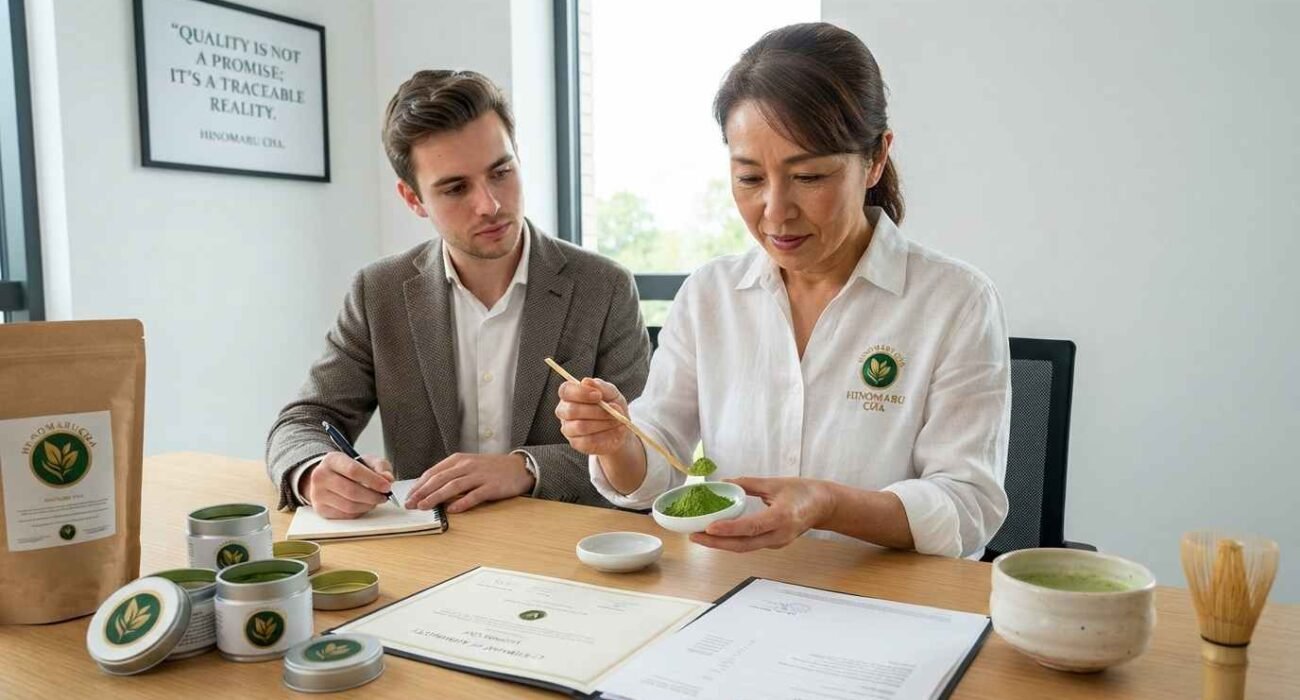
Before you commit to bulk orders, you need samples. Every serious wholesale partner offers them. Any supplier who does not is hiding something.
When you receive samples, check these five things:
Color
Authentic high-quality matcha is a vivid, saturated green, almost electric. It should not be yellowish, brownish, or dull. Fading color signals old stock, oxidation, or lower-grade leaf. Read our complete guide to matcha color, aroma, and texture →
Aroma
Good matcha smells grassy, fresh, and slightly sweet. It has a vegetal quality, like fresh spring leaves. Musty, flat, or hay-like smells mean the batch is old or poorly stored.
Texture
Ceremonial grade matcha should feel silky between your fingers. It should dissolve easily when whisked. Gritty or clumpy texture means coarser milling, often a sign of lower grade or older harvest.
Taste
Fresh, high-quality matcha has umami depth, mild sweetness, and a gentle bitterness that fades quickly. Harsh, metallic, or flat taste is a red flag.
Dissolution
Whisk a small amount with hot water (not boiling, around 70–80°C). It should form a smooth, frothy surface with no visible grains.
Our Hinomarucha Ceremonial Grade Aichi Origin 30g passes all five of these tests. Every single batch.
4. Freshness and Packaging Standards
Matcha oxidizes. It is not shelf-stable like coffee or dried herbs. Exposure to air, heat, light, and moisture degrades it within weeks.
A reliable wholesale partner treats freshness as non-negotiable.
What to look for:
- Nitrogen-sealed packaging, Replaces oxygen in the container to prevent oxidation
- Resealable or airtight cans, Preserves freshness after first opening
- Small-batch production, Means the product was milled recently, not six months ago
- Refrigerated or climate-controlled storage, Before shipping
Red flags:
- Bulk packs with no sealing details
- Unclear production or harvest dates
- Packaging that lets in light
- No guidance on how to store the product after delivery
At Hinomaru Cha, we use precision-sealed cans specifically designed for matcha storage. Our Screw Can with Pull-Top 40g and Mini Top Can Black are engineered for maximum freshness retention, both during transit and in your customer’s hands. Explore our full can series →
Learn more about how freshness shapes true ceremonial matcha quality →
5. Certifications and Testing Documentation
A reliable wholesale partner does not just talk about quality. They prove it.
Certifications that matter:
| Certification | What It Confirms |
| JAS Organic (Japan Agricultural Standard) | Grown without prohibited pesticides or synthetic fertilizers in Japan |
| USDA Organic | Meets US organic standards for import |
| EU Organic | Meets European organic import requirements |
| ISO 22000 / HACCP | Food safety management and processing standards |
| Heavy Metal Testing | Confirms safe levels of lead, arsenic, cadmium |
| Pesticide Residue Panel | Third-party verification of pesticide absence |
| Radiation Testing | Required for post-Fukushima Japan exports, reputable suppliers provide this |
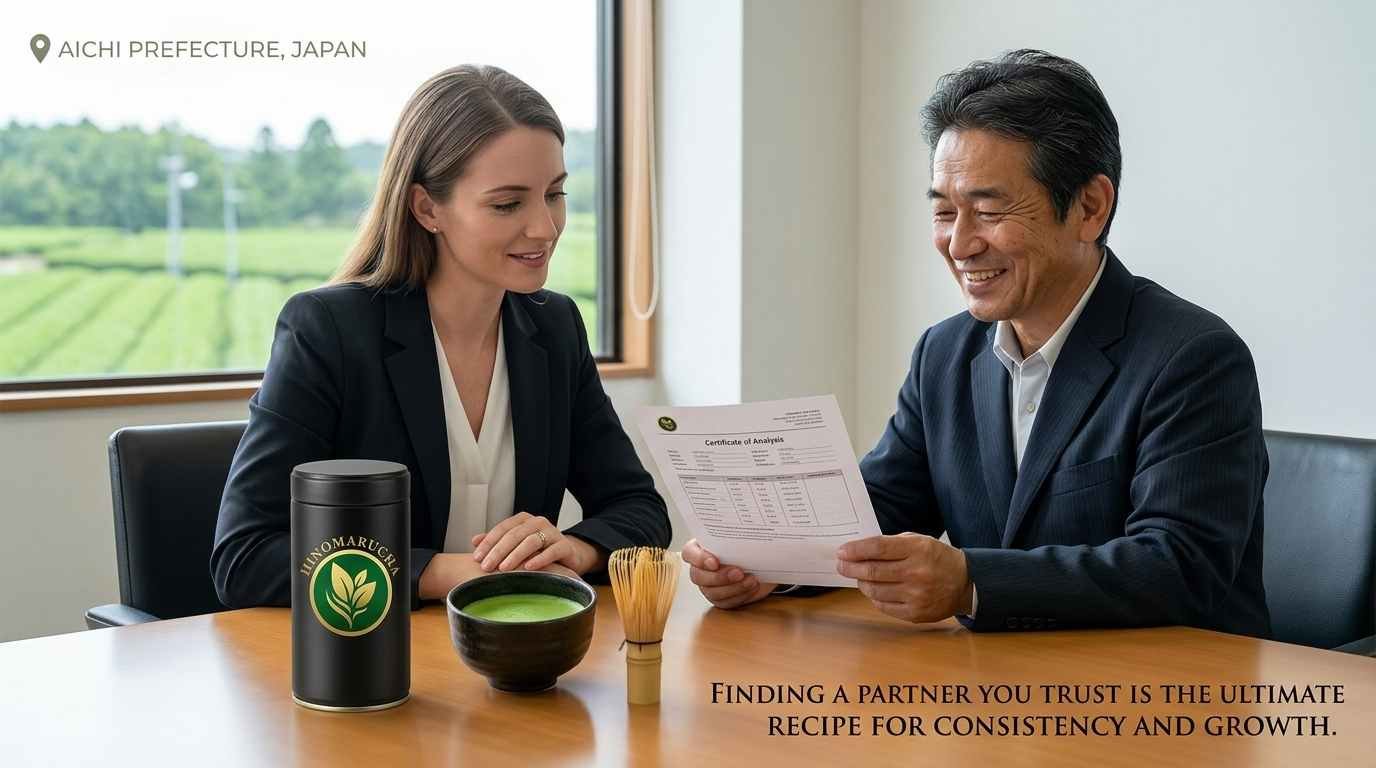
Ask your potential supplier for Certificates of Analysis (COAs) from third-party labs. Not just internal QC documents. Third-party testing is the only standard that holds up when your end customer asks questions.
We grow organically and document our process at every stage. Read our full guide to how organic matcha is grown in Japan →
6. Flexible MOQ and Scalable Ordering
Minimum Order Quantities (MOQ) make or break early-stage matcha businesses. A supplier who requires you to commit to 50kg on your first order is not a partner, they are a risk.
What good wholesale partners offer:
- Low MOQ entry points (1–5kg for sampling and initial product testing)
- Clear price breaks at higher volumes (so scaling feels rewarding, not punitive)
- Flexible reorder windows (not a fixed calendar that does not match your sales cycle)
- Honest lead times (2–6 weeks from Japan is standard; same-week promises from “Japanese suppliers” shipping from local warehouses are a warning sign)
Volume pricing benchmark:
| Order Volume | Typical Market Range (per 100g) | What Hinomaru Cha Offers |
| 1–5 kg | 18–30 | Competitive ceremonial grade pricing with direct farm relationship |
| 5–20 kg | 14–22 | Discounted wholesale tiers available |
| 20 kg+ | 10–18 | Custom wholesale agreements; contact us |
We work with cafes, wellness brands, e-commerce businesses, and corporate gifting companies. We size the order to your stage. You do not need to over-commit to work with us.
Read our complete guide to matcha wholesale in 2026 →
7. Custom Packaging and Private Label Options
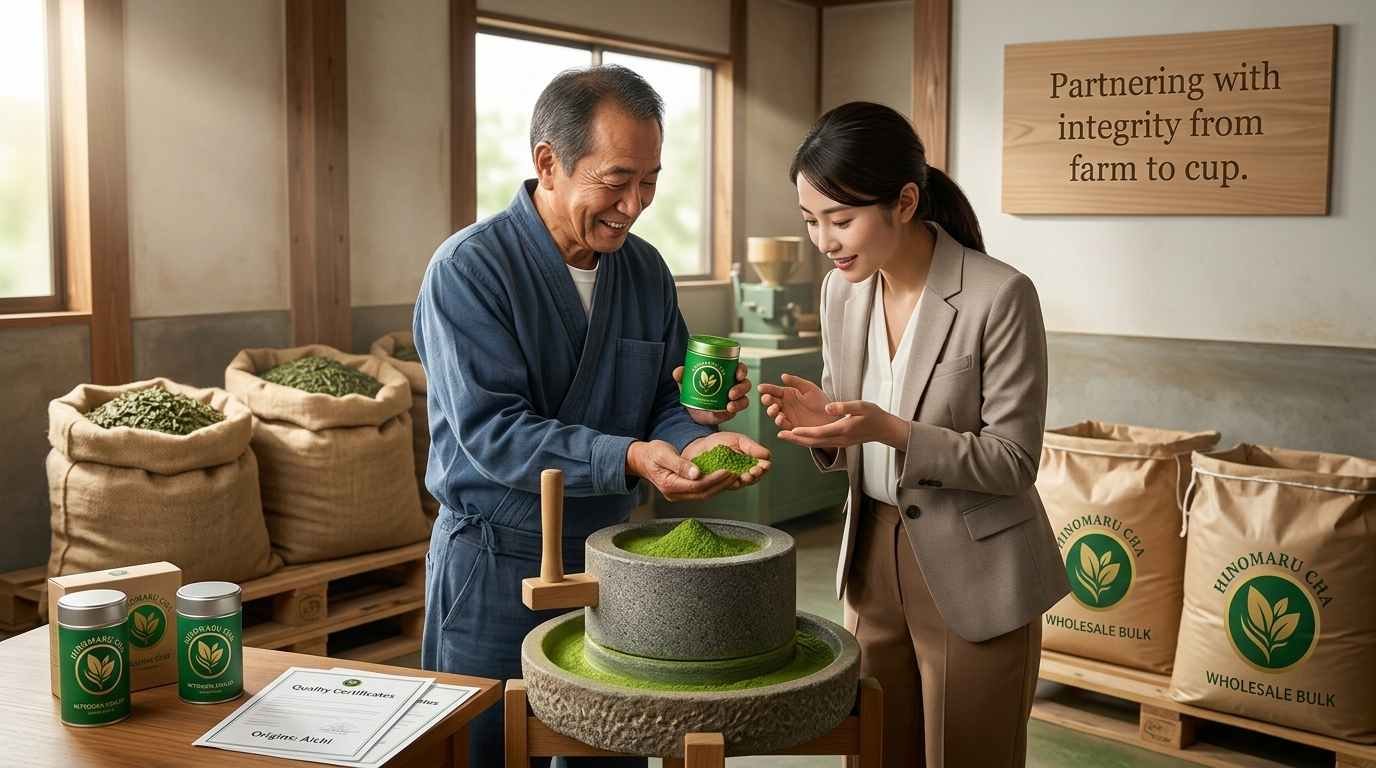
If you are building a matcha brand, your packaging is your product’s first impression. A good wholesale partner helps you get this right.
What to expect from a reliable partner:
- Private label options, Your brand name on our quality product
- Custom can designs, Artwork, logo, color scheme options
- Variety of pack formats, From retail single-serve to café bulk bags
- MOQ for custom packaging, Should be transparent and reasonable
We offer a stunning range of packaging options that your customers will actually keep and display.
Our Artisan Art Can, Geisha and Artisanal Art Can, Mt. Fuji are among our most popular retail-ready formats. The Mini Can Soft Matte is perfect for premium minimalist brands. The Anime Nittoh Cans appeal to the younger, playful matcha market.
Our Genuine Gold Lacquer packaging is in a category of its own, it signals luxury before anyone opens the lid.
For corporate gifting or gifting-focused e-commerce, our Mini Can Series Box makes the unboxing experience genuinely special.
8. Partnership Support, Beyond Just Selling
The best wholesale partners do not disappear after the first invoice. They help you grow.
Ask potential suppliers:
- Do they provide product education resources?
- Do they help with sourcing guidance?
- Do they share brewing guides or preparation content you can use with your customers?
- Do they have a contact you can reach when something goes wrong?
We do all of this. Our knowledge base covers everything from how to start a matcha business with a Japanese supplier to how to make a matcha latte at home, content you can share with your own customers to drive engagement and repeat purchases.
We also provide the accessories your customers need to get the most from our matcha. Our Bamboo Chasen (traditional matcha whisk), Mug Tea Whisk, and Matcha 3 Piece Set are perfect for bundling with your own matcha product, increasing average order value while enhancing customer experience.
Supplier Comparison, What Separates Reliable from Risky
Here is a side-by-side breakdown of what a reliable matcha wholesale partner offers compared to what unreliable ones often do.
| Evaluation Criteria | Reliable Partner (e.g., Hinomaru Cha) | Risky/Unreliable Supplier |
| Farm origin transparency | Named prefecture, farm, harvest season | Vague “imported from Japan” with no details |
| Grade classification | Honest, use-case matched grading | Ceremonial grade labeling on culinary product |
| Certifications | Third-party COAs, organic certification | Internal-only quality claims |
| Freshness controls | Nitrogen sealed, dated, small-batch | Bulk packs with no production dates |
| Sample availability | Yes, before bulk commitment | No samples or hidden fees for samples |
| MOQ flexibility | Low entry point, scalable pricing | High MOQ with no flexibility |
| Packaging options | Custom and branded options available | Standard bag only, no customization |
| Partnership support | Education content, brewing guides, account contact | No support after purchase |
| Communication | Responsive, transparent, proactive | Slow or evasive responses |
| Sustainability | Documented farming practices | No sustainability information |
Why Origin Integrity Is a Non-Negotiable in 2026?
The matcha market has grown fast. And with growth comes imitation.
Studies by the Global Tea Initiative found that a significant portion of matcha labeled “Japanese” is actually blended or grown in China or Korea and processed in Japan to qualify for the label. This is legal in some cases. But it is not what your customers are paying for.
The quality difference is real:
- Japanese matcha uses specific tencha leaf preparation, shade-grown, steamed, dried, and stone-milled
- The soil composition in regions like Aichi, Uji, and Nishio produces a specific amino acid (L-theanine) profile that gives matcha its famous calm-focus effect
- Japanese stone mills produce finer powder (measured in microns) compared to industrial ball mills used in mass production
Read about what makes Japanese matcha genuinely different from other countries →
Understand the tencha leaf to powder process in full →
When you source from Hinomaru Cha, you source from the origin, not from a middleman who bought from a broker who bought from a warehouse in Yokohama.
The Role of Soil, Climate, and Farming in Matcha Quality
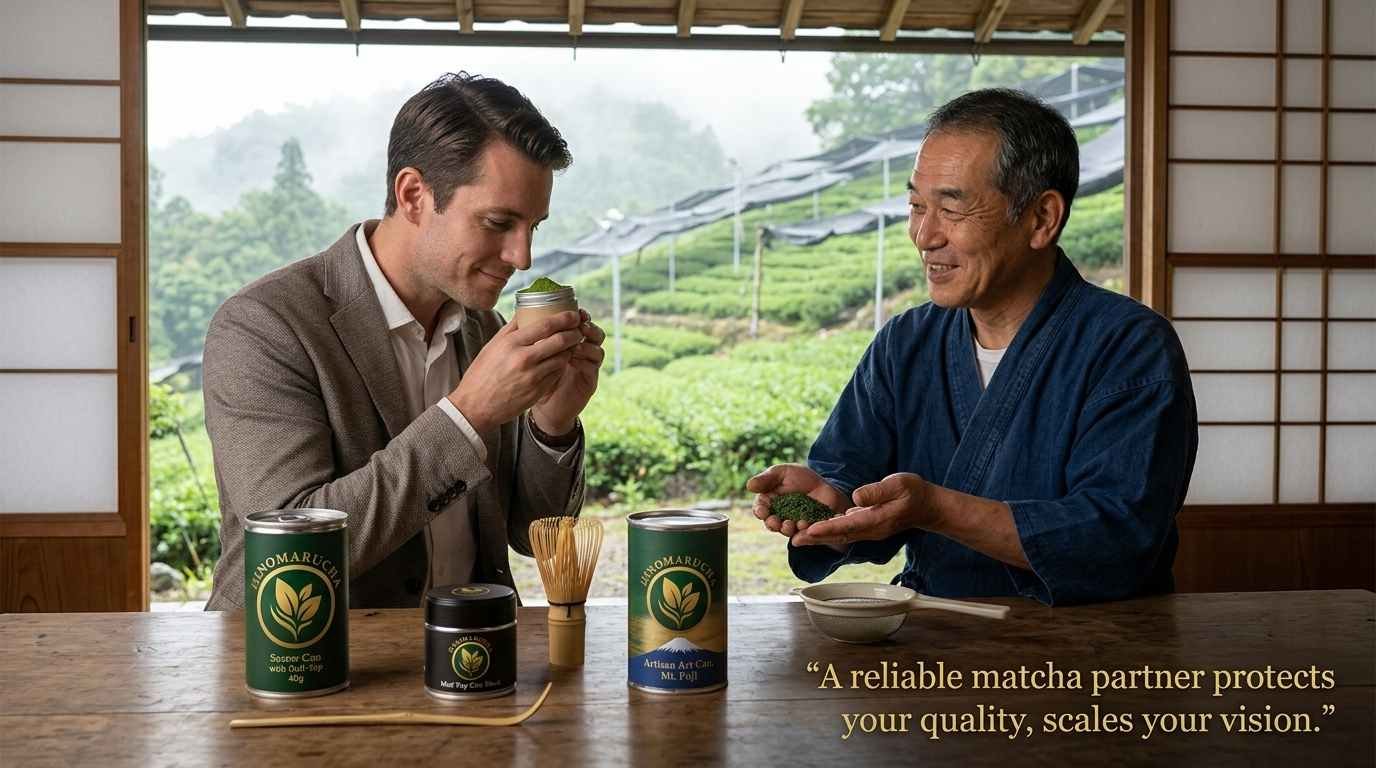
You can not separate the product from the place it grows.
Soil: Aichi’s volcanic clay-loam soils retain moisture while providing excellent drainage. They are naturally rich in minerals that support healthy tencha leaf development.
Climate: The temperate Aichi climate, with warm summers and mild winters, creates ideal growing conditions. Temperature variation between seasons concentrates flavor compounds in the leaf.
Shading: Tencha plants used for matcha are shade-covered for 20–30 days before harvest. This increases chlorophyll (responsible for green color), L-theanine (responsible for umami and calm focus), and reduces catechins that cause excessive bitterness.
Small-batch processing: Mass production skips steps. Small-batch production does not. Every Hinomaru Cha harvest is processed in controlled batches, milled, sealed, and shipped without sitting in a warehouse for months.
Why soil and climate matter in matcha quality, our deep dive →
How small-batch production preserves matcha freshness →
Pros and Cons, Working with a Direct Japanese Supplier vs. a Domestic Reseller
This is a question many new matcha businesses get wrong. Here is the honest breakdown.
Working Directly with a Japanese Wholesale Supplier (like Hinomaru Cha)
Pros:
- Direct access to verified source origin
- Better price per kg (no middleman markup)
- Custom packaging and private label relationships are easier to negotiate
- You know exactly what you are getting and where it came from
- Full certification chain available
- Longer-term partnership with production insights
Cons:
- Longer lead times (2–6 weeks from Japan)
- Higher initial coordination effort (time zones, language occasionally)
- Minimum order quantities still apply at some tier levels
Working with a Domestic Matcha Reseller
Pros:
- Faster shipping within your country
- Easier returns or short-term arrangements
- No import logistics to manage
Cons:
- Significant markup, you are paying for their margin
- Origin transparency is often thin or absent
- No relationship with the actual farm or producer
- Private label options are limited or off-brand
- Quality consistency depends on their supplier, which you cannot verify
Verdict: For any business serious about building a premium matcha brand, the direct Japanese supplier relationship wins. The logistics cost is quickly offset by the margin and authenticity advantages.
Sustainability as a Buying Criterion
Matcha consumers in 2026 care deeply about sustainability. It is not a nice-to-have anymore. It is a sales driver.
What to ask your potential wholesale partner:
- Do they use chemical-free, organic farming methods?
- Are their farms using sustainable water management?
- Is packaging recyclable or biodegradable?
- Do they support the livelihoods of small-scale Japanese farmers rather than consolidating supply into industrial operations?
At Hinomaru Cha, our farming partners practice sustainable, traditional agriculture rooted in Japanese growing philosophy. We do not use synthetic pesticides. We support the preservation of small-farm cultivation, which produces better tea and keeps generational farming knowledge alive.
Our full guide to sustainable matcha farming practices in Japan →
What Our Product Range Offers Your Business?
Hinomaru Cha is not just a matcha supplier. We are a full-spectrum Japanese tea partner.
Our Matcha Range
Our ceremonial grade matcha, sourced from Aichi and available in our Hinomarucha Ceremonial Grade Aichi Origin 30g, is the benchmark for everything we offer. It is shade-grown, stone-milled, nitrogen-sealed, and freshness-dated.
We also offer Houjicha Powder for businesses looking to expand into Japan’s growing roasted green tea segment. Houjicha is warming, low-caffeine, and growing rapidly in Western wellness markets.
Our Packaging Range
Your packaging tells your brand story before a single sip.
- Screw Can with Pull-Top 40g, Classic, durable, reusable
- Mini Top Can Silver, Sleek and premium
- Mini Can Soft Matte, Tactile luxury finish
- Artisan Art Can, Geisha, Statement collector’s piece
- Artisanal Art Can, Mt. Fuji, Iconic Japanese heritage
- Anime Nittoh Cans, For the cultural matcha market
- Genuine Gold Lacquer, Luxury gifting
- Mini Can Series Box, Gift sets and unboxing appeal
Our Accessories Range
Accessories complete the matcha experience for your customers.
- Bamboo Chasen, Traditional 100-prong whisk for authentic preparation
- Mug Tea Whisk, Modern everyday option
- Matcha 3 Piece Set, Curated starter kit for new customers
- 3 Piece Matcha Set, Sosuno and Gosu, Artisanal ceramic set for premium positioning
- Matcha Can Sieve, Essential for smooth, clump-free preparation
- Hitoshizuku Teapot Tea, Japanese brewing elegance
Bundling accessories with your matcha drives higher average order values. It also means your customers actually enjoy their matcha the right way, which keeps them buying.
Understanding Matcha’s Health Profile, and Why It Supports Your Positioning
The modern matcha market is driven heavily by health consciousness. Understanding what matcha delivers, and communicating it accurately, gives your brand a real edge.
Key health attributes:
- L-Theanine, An amino acid unique to tea that promotes calm, focused alertness without the jitters of coffee
- Catechins (EGCG), Powerful antioxidants linked to metabolic support and cellular protection
- Chlorophyll, Gives matcha its color and has been studied for detox support
- Caffeine, A moderate, smooth energy release when combined with L-theanine
Research note: Matcha contains approximately 3x the antioxidants of regular green tea per gram, according to research published in the Journal of Chromatography A. The whole-leaf consumption (rather than steeped and discarded) is why.
Explore the top 10 science-backed health benefits of Japanese green tea →
Learn how matcha became a modern wellness ritual →
This health story is your marketing story. A reliable wholesale partner gives you the product quality that makes those claims real, not aspirational.
How to Evaluate a Supplier Before You Commit?
Here is a practical framework. Use this checklist when approaching any matcha wholesale supplier, including us.
Pre-Engagement Checklist
- Can they name the farm region and harvest season?
- Do they provide third-party certificates of analysis?
- Do they offer samples before bulk orders?
- Is their grade classification explained clearly with use-case guidance?
- Is their packaging designed to protect freshness?
- Do they list production dates or freshness windows?
- Is their MOQ realistic for your current stage?
- Do they offer private label or custom packaging?
- Are they responsive within 24–48 hours?
- Do they have published content showing product knowledge depth?
First Sample Evaluation
- Color: Vivid green, no yellowing or browning
- Aroma: Fresh, grassy, slightly sweet, not musty
- Texture: Silky, fine, no grittiness
- Taste: Umami forward, gentle bitterness, no metallic or flat notes
- Dissolution: Smooth and frothy when whisked properly
If a supplier passes both checklists, you have a serious candidate.
How to tell if matcha is truly ceremonial grade →
The Best Way to Store Matcha After You Receive It
Even perfect matcha goes bad with poor storage. Your wholesale partner should give you clear guidance on this.
Best practices:
- Keep sealed containers in the refrigerator (below 10°C / 50°F)
- After opening, consume within 4–6 weeks for optimal flavor
- Always use a dry spoon, moisture is the enemy
- Keep away from strong-smelling foods (matcha absorbs odors)
- Store in an airtight container away from direct light
Our packaging is designed to make storage easy. Our cans seal properly. They protect against light. They are sized for realistic consumption windows, so your customers actually finish the product at peak quality.
Full guide to the best ways to store matcha to preserve flavor →
Market Data, Matcha Wholesale Trends in 2026
Understanding the market landscape helps you position your business correctly and choose a partner who can grow with you.
| Metric | Data |
| Global matcha market size (2024) | USD 4.5 billion |
| Projected market size (2030) | USD 8.1 billion |
| CAGR (2024–2030) | 9.6% |
| Top consuming regions | North America, Europe, East Asia |
| Fastest-growing segment | Ready-to-drink beverages and wellness products |
| Key consumer driver | Health benefits and clean label trend |
| Average retail price premium (Japan-origin vs generic) | 35–60% |
| Top end-use categories | Cafes, wellness brands, food manufacturing, gifting |
Sources: Grand View Research Global Matcha Market Report 2024; Euromonitor International Tea Market Analysis 2025.
What this means for you: The premium segment is growing fastest. Businesses that position on Japanese origin, organic certification, and product transparency will capture disproportionate market growth. Your wholesale partner needs to give you the product that earns that premium, consistently.
Why Hinomaru Cha Is Built to Be Your Long-Term Partner?
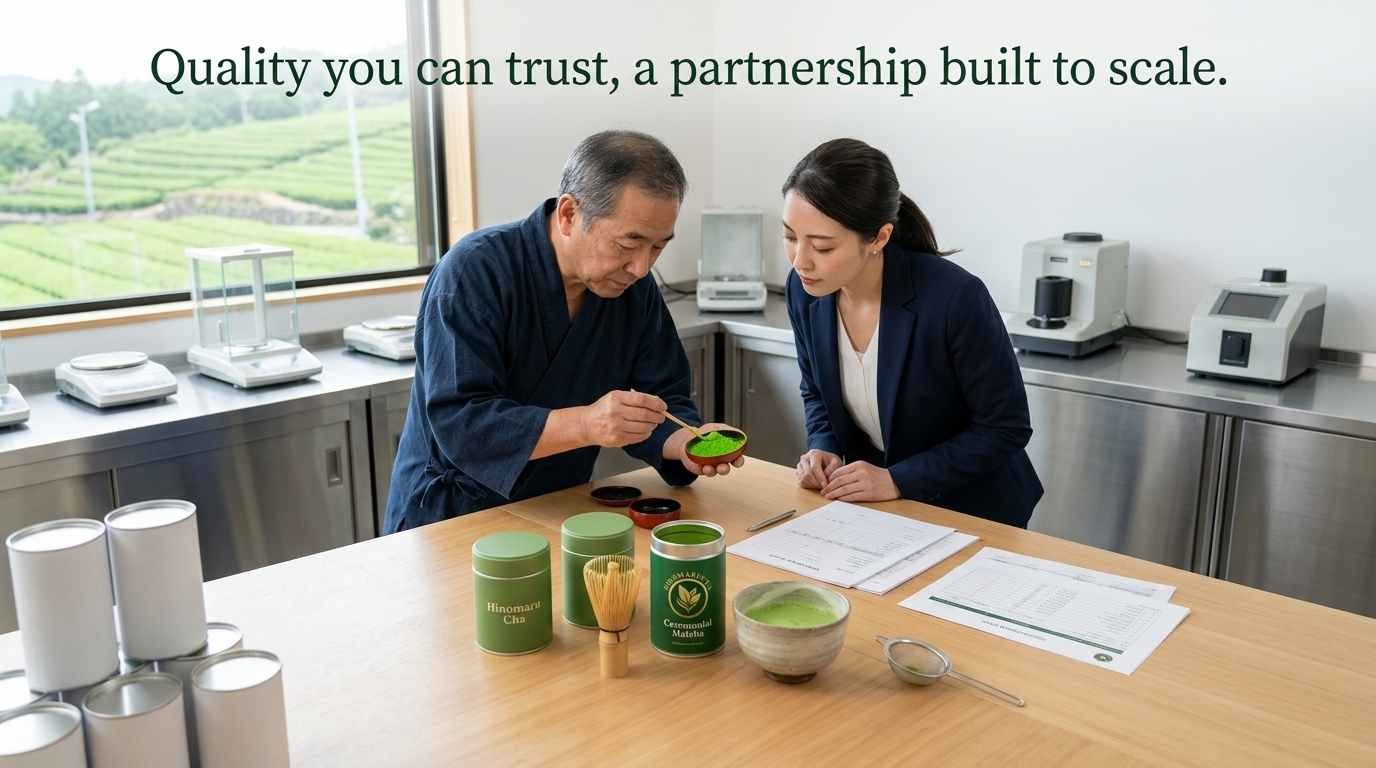
We have covered a lot of criteria. Let us be direct about how we meet them.
Origin: Aichi Prefecture. Named farm relationships. Traceable to harvest season.
Quality: Ceremonial and culinary grades, clearly differentiated, honestly described. Sample-first policy.
Freshness: Nitrogen-sealed, small-batch production, freshness-dated. Our cans are engineered for matcha, not repurposed tins.
Certifications: Organic farming practices, documented at every stage. Available COAs on request.
Packaging: One of the most extensive premium packaging ranges in the matcha wholesale market. From minimalist matte cans to luxury gold lacquer to artisanal art editions.
Flexibility: Scalable from small initial orders to high-volume wholesale agreements. We work with your stage, not against it.
Support: Deep product education, brewing content, business guidance, and an accessible team.
Sustainability: Traditional Japanese small-farm methods. No mass industrial production. Real environmental accountability.
We are not the cheapest option. We are the most valuable option, because we protect your brand as carefully as we protect our matcha.
Start exploring our products →
Read our complete 2026 matcha wholesale guide →
Conclusion
Choosing a reliable matcha wholesale partner is not about finding the lowest price. It is about finding the partner who protects your product quality, supports your brand story, and scales with your business.
The right partner gives you:
- Traceable Japanese origin
- Honest, verified grade classification
- Freshness-first packaging
- Third-party certification documentation
- Flexible ordering that matches your growth stage
- Custom packaging that tells your brand story
- Ongoing support, not just transactions
At Hinomaru Cha, every one of those things is built into how we operate. Not as a marketing promise, as a production and operational standard.
If you are serious about building a matcha business that lasts, we would like to be the supplier behind it.
Frequently Asked Questions
- What is the minimum order quantity for matcha wholesale at Hinomaru Cha?
We offer flexible entry-level MOQs designed for new and growing businesses. Contact us directly to discuss your volume needs and we will match an order structure to your current stage, without pressuring you to over-commit.
- How do I know if a matcha wholesale supplier is selling genuine Japanese matcha?
Ask for the specific prefecture of origin, the farm relationship, the harvest season, and third-party certificates of analysis. Vague answers or internal-only documentation are warning signs. Genuine Japanese suppliers name their origin specifically.
- What certifications should I ask for before ordering wholesale matcha?
Request JAS Organic or USDA Organic certification, third-party pesticide residue panels, heavy metal test results, and radiation testing documentation. Reliable suppliers provide these proactively. Hesitation to share them is a red flag.
- Can I get custom packaging for my matcha brand through Hinomaru Cha?
Yes. We offer a wide range of premium cans and packaging formats, including private label options. From minimalist matte cans to luxury artisanal art cans, we can align packaging to your brand identity. Contact our team to discuss your requirements.
- How long does wholesale matcha from Japan stay fresh after delivery?
Properly nitrogen-sealed matcha stays fresh for 12–18 months unopened when stored below 10°C. After opening, consume within 4–6 weeks for optimal flavor. Our packaging is specifically engineered to maximize this freshness window from farm to your customer.