



The matcha market has a problem — and it’s getting worse.
As global demand for matcha has exploded (Japan’s matcha exports surged over 75% in 2024 alone), the market has flooded with products claiming to be “ceremonial grade” that simply aren’t. Tins with beautiful Japanese-inspired packaging, premium pricing, and bold grade claims often contain matcha that would not pass the most basic quality test in Japan.
The hard truth: “ceremonial grade” is not a regulated term. No government body, no official certification, no international standard defines it. Any brand can print it on any tin. The label alone tells you almost nothing.
So how do you actually know if the matcha in front of you is the real thing?
At Hinomarucha, we’ve spent years sourcing directly from Japan’s finest tea gardens. In this guide, we’ll give you the exact tests and signals — visual, tactile, olfactory, and taste-based — that expert tea buyers use to evaluate ceremonial matcha quality. After reading this, you’ll never be fooled by a label again.
New to matcha grades? Start with What Is Ceremonial Grade Matcha? A Complete Expert Guide to understand the foundations before applying these tests.
Why This Matters More Than Ever
The global matcha boom has created a supply shortage of genuine first-flush, shade-grown tencha — the raw material of real ceremonial matcha. Tencha bushes take five years to mature before they can be harvested. Supply simply cannot grow fast enough to meet demand.
This gap is being filled by opportunistic products: lower-grade green tea powders, Chinese-grown matcha dyed to appear greener, and culinary-grade powder in premium-priced tins. Knowing how to evaluate quality yourself is no longer optional — it’s essential consumer knowledge for anyone spending money on ceremonial matcha.
Here are the nine definitive tests, in the order you should apply them.
The Color Test — Your First and Most Reliable Signal
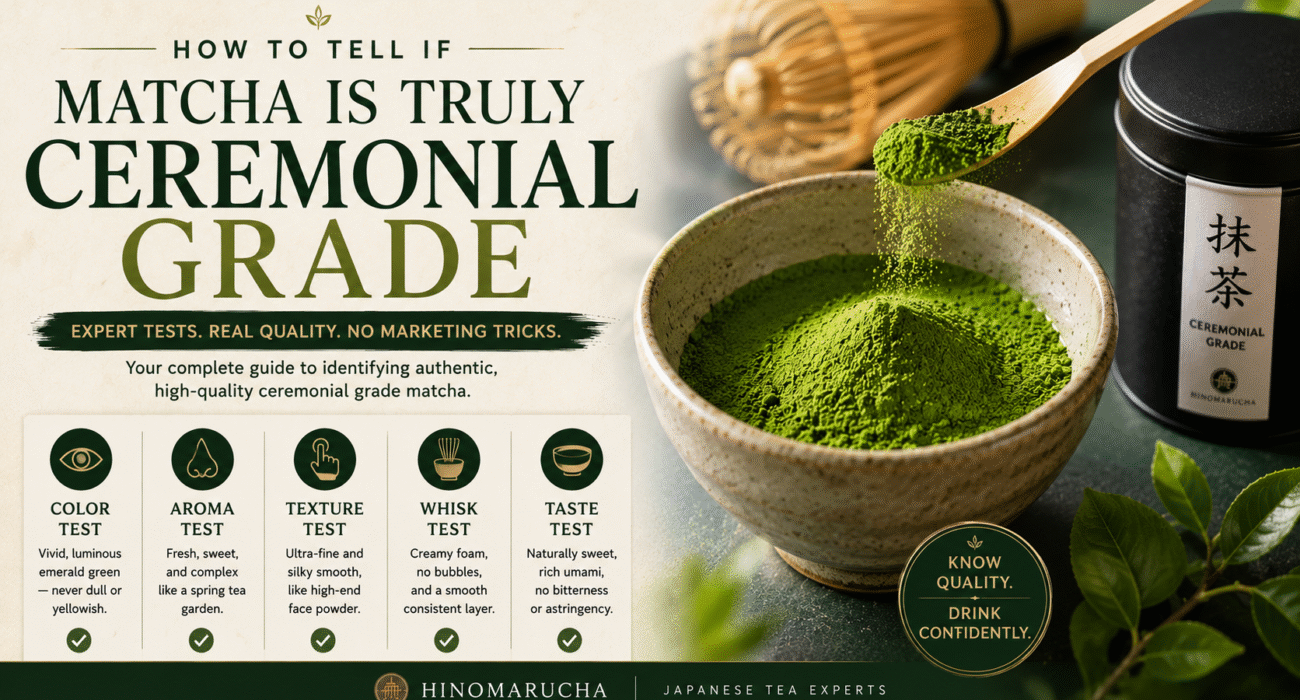
What to look for: Open the tin under natural daylight and observe the color immediately. True ceremonial grade matcha is a vivid, luminous, electric emerald green — sometimes described as almost glowing. It should look alive, vibrant, and deeply saturated.
What disqualifies it:
- Yellow-green or olive tones — indicates older leaves, excessive sun exposure during growth, or late-harvest material
- Dull, flat, or muted green — suggests oxidation from age or improper storage, or lower-grade leaf selection
- Artificially bright or neon-looking — occasionally, additives are used; genuine ceremonial matcha’s brightness comes from natural chlorophyll, not enhancement
Why color matters scientifically: The vivid green color of ceremonial matcha comes directly from chlorophyll concentration — which is maximized by 20–30+ days of shade-growing before harvest. The shade stimulates chlorophyll production as the plant strains toward limited light. First-flush, heavily shaded leaves are extraordinarily rich in chlorophyll. Later-harvest or less-shaded leaves have lower chlorophyll, producing the duller colors you see in culinary-grade or mislabeled products.
Quick comparison test: Place the matcha next to fresh spinach leaves or a vibrant green apple. Ceremonial grade matcha should match or exceed that intensity of green. If it looks more like dried herbs or pea soup, it’s not ceremonial grade.
The Aroma Test — The Nose Knows
What to look for: Bring the open tin close to your nose immediately after opening. Authentic ceremonial matcha has a fresh, sweet, complex fragrance — often described as:
- A spring tea garden after light rain
- Fresh-cut young grass with a subtle floral undertone
- Clean, green, and slightly oceanic (reminiscent of nori or edamame)
This characteristic fragrance is called ooi-ka in Japanese — the distinctive scent of shade-grown tea, created by the accumulation of aroma compounds in leaves grown under reduced sunlight.
What disqualifies it:
- Hay-like, dry, or dusty smell — indicates old matcha or improper storage; oxidation destroys the fresh aroma compounds
- Stale or flat — the green freshness should be immediate and striking, not faint
- Fishy or musty notes — a sign of contamination or very poor storage conditions
- Nothing at all — if you have to search for the aroma, the matcha is too old or too low quality
The freshness rule: Ceremonial grade matcha has a pronounced, immediate aroma that hits you before you even put the tin to your nose. If you have to actively search for it, something is wrong.
The Texture Test — Silk vs. Sand
What to do: Scoop a small pinch of matcha and rub it firmly between your thumb and index finger for 3–5 seconds.
What to feel: True ceremonial grade matcha feels impossibly fine and silky — closer to high-end face powder or fine talc than anything you’d associate with a food product. It should glide between your fingers with zero detectable graininess.
What disqualifies it:
- Any grittiness or roughness — indicates coarser grinding, which is typical of culinary-grade production methods
- Powdery but not silky — there’s a difference between fine powder and ultra-fine silk; culinary grade can be powdery but won’t have the silky slide of true ceremonial
- Clumps that resist pressure — while all matcha clumps (more on this below), ceremonial grade clumps should dissolve instantly under the lightest finger pressure
Why texture matters: Ceremonial grade matcha is ground on traditional granite stone mills (ishiusu) turning at just 30–40 rotations per minute. This slow, low-heat process produces particles of 5–10 microns — finer than anything achievable with modern high-speed industrial grinders. This ultra-fine grind is not just aesthetic; it’s what creates the smooth suspension, the creamy foam when whisked, and the absence of bitter clumping in the cup.
The Clump Test — A Quality Paradox
The counterintuitive truth: Clumping in matcha is actually a sign of quality, not a flaw.
Because ceremonial grade matcha is ground to such an extreme fineness (5–10 microns), the particles have an enormous surface area and are highly electrostatically active — they cling together readily. Open any tin of genuine high-quality ceremonial matcha and you’ll see small clumps throughout the powder.
What this means in practice:
- Lots of natural clumping → positive indicator of ultra-fine, proper stone-grinding
- Perfectly free-flowing, zero clumping → often indicates coarser, industrial grinding (culinary grade behavior)
Important nuance: The clumps should dissolve instantly when you sift the powder or press with a finger. They are soft, airy aggregations of ultra-fine particles — not hard lumps of poorly ground powder. If the clumps resist sifting or whisking, that’s a different issue (usually moisture contamination or old matcha).
Always sift ceremonial grade matcha before whisking — not because it’s poor quality, but because its fineness makes clumping inevitable and sifting restores the powder’s silky smoothness before preparation. See our full guide to preparing ceremonial matcha properly for step-by-step technique.
The Dissolution Test — No Residue Left Behind
What to do: Prepare a small amount of matcha using correct technique — 1.5g whisked into 70ml of water at 75°C with a chasen for 15–20 seconds.
What to look for: Allow the whisked matcha to sit undisturbed for 60 seconds after preparation, then observe the bottom of the bowl.
What to expect from ceremonial grade:
- The liquid should remain uniformly green and slightly translucent throughout
- Any very light, temporary settling is acceptable
- The foam (crema) on the surface should be fine-bubbled, stable, and last at least 30–60 seconds
What disqualifies it:
- Significant sediment or gritty residue at the bottom of the bowl — indicates coarser grinding that cannot fully suspend in water
- Foam that disappears in seconds — fine, stable foam requires the ultra-fine particle size of genuine ceremonial grade
- Visibly grainy texture when drinking — should be smooth and creamy, never gritty
The Taste Test — The Ultimate Verdict
This is the definitive test, and no visual or tactile check replaces it.
How to prepare for an honest taste test:
- Use water at 70–80°C (never boiling — boiling water destroys L-theanine and makes even good matcha taste bitter)
- Use a proper chasen (bamboo whisk) — or at minimum a small electric milk frother
- Taste plain, with no milk, sugar, or additives
What ceremonial grade tastes like:
- Naturally sweet on the first sip — a smooth, round sweetness that requires no sugar. This comes from L-theanine, not added ingredients
- Deep umami — a savory, almost brothy quality similar to edamame, good dashi, or seaweed. This is the hallmark of shade-grown, L-theanine-rich first-flush leaves
- Clean, lingering finish — the taste should remain pleasant in your mouth for 30–60 seconds after swallowing, growing sweeter rather than bitter
- Zero harsh bitterness — a gentle, balanced astringency is acceptable in some ceremonial grades, but harsh, throat-catching bitterness is not
What disqualifies it:
- Immediate bitterness on the first sip (assuming correct water temperature) — indicates lower-grade leaf selection, late harvest, or insufficient shading
- No sweetness whatsoever — authentic ceremonial grade has natural sweetness; its absence indicates inadequate L-theanine from poor shading
- Flat, thin, watery flavor — good ceremonial matcha has depth and body even in thin (usucha) preparation
- Unpleasant aftertaste — the finish should be clean and pleasant, not astringent or metallic
Important: If your matcha tastes bitter, check your water temperature first. Water above 85°C will make even exceptional ceremonial matcha taste harsh. If bitterness persists at correct temperature (70–80°C), the matcha itself is the issue. Read our guide on Ceremonial vs Culinary Matcha to understand how grade affects taste.
The Origin and Sourcing Transparency Test
What to verify on the packaging or product page:
✅ Specific Japanese growing region named Authentic ceremonial matcha comes from Japan’s established tea-growing regions. Look for: Uji (Kyoto), Nishio (Aichi), Yame (Fukuoka), Kagoshima, or Shizuoka. Vague labeling like “Product of Japan” without naming the specific prefecture or region is a yellow flag.
✅ Harvest flush specified The packaging or product description should indicate first flush / ichibancha / first harvest. This tells you the leaves came from the correct picking window (late April to mid-May). No flush information = no confidence in the grade claim.
✅ Harvest date or production date visible Matcha does not improve with age. Genuine ceremonial-grade producers are proud of their freshness and include the harvest year and ideally the month. If you can’t find a production or harvest date anywhere, treat that as a warning.
✅ Shading duration disclosed Some premium producers specify their shading duration (e.g., “shaded for 25 days”). This is a mark of transparency and quality confidence. You won’t see this on low-grade products.
✅ Stone-grinding confirmed Look for “stone-ground” or “ishiusu” on the packaging. Some brands will be specific about their milling process. Stone-ground = slow, low-heat, ultra-fine. Industrial ball-mill or jet-milled matcha does not produce the same particle size or quality.
The Price Test — The Floor That Matters
Authentic ceremonial grade matcha has a real cost floor that cannot be avoided. The production math is straightforward:
- A single stone mill produces 30–40g of matcha per hour
- First-flush hand-harvesting, extended shading management, de-stemming, and slow stone-grinding are all labor-intensive
- Tencha (the raw material for matcha) prices hit record highs in recent years — a May 2025 Kyoto auction saw tencha prices climb 170% year-over-year, driven by supply shortages
What the numbers mean for you:
- Under $15 for 30g labeled “ceremonial grade” → almost certainly not genuine ceremonial grade
- $20–30 for 30g → entry-level ceremonial; possible but check all other tests carefully
- $30–60+ for 30g → consistent with genuine premium ceremonial grade production costs
- $60+ for 30g → competition-grade or single-estate premium; the highest tier
The important caveat: A high price alone does not guarantee quality. Some brands charge premium prices for mediocre matcha using marketing rather than actual quality. Price is a necessary but not sufficient condition. Use it as a floor test (too cheap = red flag) but always combine with the other tests above.
The Brand Transparency Test — Ask the Hard Questions
The most reliable ceremonial matcha brands welcome scrutiny. They can answer:
- Which specific farm or cooperative does this come from?
- What harvest year and month is this batch from?
- How long were the plants shaded before harvest?
- What is the grinding method and particle size?
- Is there a Certificate of Analysis (COA) available? (Covers pesticide residues, heavy metals, and microbial safety)
Brands that deflect these questions, provide vague answers, or simply point back to their marketing copy are telling you something important about their supply chain confidence.
At Hinomarucha, we provide complete sourcing transparency — region, farm, harvest date, and shading duration — for every ceremonial matcha we offer. Browse our full ceremonial matcha collection to see this in practice.
The Quickest Ways to Spot Fake “Ceremonial Grade”
Use this as a fast-reference checklist when evaluating any matcha:
| 🚩 Red Flag | What It Suggests |
|---|---|
| Dull, yellow-green, or olive color | Low-grade leaves, insufficient shading, or old stock |
| Stale, hay-like, or no aroma | Old matcha or oxidized; not fresh first-flush |
| Gritty texture when rubbed | Industrial grinding, not stone-milled |
| Tastes immediately bitter (at 75°C water) | Lower-grade leaves, late harvest, poor shading |
| No sweetness without added sugar | Insufficient L-theanine = inadequate shading or wrong flush |
| “Product of Japan” with no region named | Lack of supply chain transparency |
| No harvest or production date visible | Brand not confident in freshness |
| Priced under $15 per 30g | Cannot cover genuine ceremonial production costs |
| “Ceremonial grade” with no other specifications | Label-only claim, no substantiating quality indicators |
| Origin listed outside Japan (e.g., China) | Not traditional matcha production standards |
The Counterfeiting Problem Is Growing
It’s worth noting why these skills matter now more than ever. Japan’s Kyoto Prefectural Tea Chamber applied in 2023 to register tencha under Japan’s Geographical Indication (GI) system — specifically to combat the growing problem of counterfeit and mislabeled matcha abroad. Once approved, only tea produced in Kyoto Prefecture using hand-picked first-flush leaves will be permitted to carry the GI certification mark.
This tells you something important: even within Japan’s official tea industry, the mislabeling of matcha has become serious enough to require legal protection. As a consumer, your ability to evaluate quality independently is your best defense.
For more context on how Japan’s tea export standards and quality verification work, the Japan External Trade Organization (JETRO) provides authoritative information on the regulatory landscape for Japanese agricultural exports, including tea certification standards.
Summary: Your 9-Point Ceremonial Matcha Quality Checklist
Before buying or after receiving your matcha, run through these checks:
Visual (before opening):
- Packaging specifies Japanese growing region (not just “Product of Japan”)
- Harvest flush (first flush / ichibancha) is stated
- Harvest or production date is visible
- Price is consistent with real ceremonial production costs ($25+ per 30g)
Visual (after opening):
- Color is vivid, electric emerald green — not dull, yellow, or olive
- Natural clumping is present (positive sign of ultra-fine grinding)
Tactile:
- Powder feels silk-smooth between fingers — no grittiness
Olfactory:
- Aroma is fresh, sweet, and grassy — immediate and pleasant on opening
Taste (prepared at 70–80°C, plain):
- Naturally sweet without any added sugar
- Rich umami depth
- No harsh bitterness on first sip
- Clean, pleasant, lingering finish
Frequently Asked Questions
Q: Can matcha pass the color test but fail the taste test? Yes — and this happens more often than you’d think. Some producers add chlorophyll or use specific processing to maintain color while using lower-quality leaves. Always taste-test. Color is a necessary but not sufficient indicator of quality.
Q: My matcha clumps a lot. Is something wrong with it? Almost certainly not — in fact, significant clumping is a positive sign of ultra-fine stone-grinding. Always sift ceremonial grade matcha through a fine mesh strainer before whisking. The proper preparation guide covers exactly how to do this.
Q: I bought “ceremonial grade” but it tastes bitter. Did I waste my money? Check the water temperature first — it should be 70–80°C, not boiling. If bitterness persists at the correct temperature, you may have received mislabeled culinary-grade matcha. Refer to our Ceremonial vs Culinary Matcha guide for what each grade should taste like.
Q: Does organic certification guarantee ceremonial quality? No. Organic and ceremonial are independent criteria. Organic certification (JAS in Japan, USDA in the US) addresses farming methods and absence of synthetic pesticides — not harvest flush, shading duration, or leaf quality. A matcha can be organic and poor ceremonial quality, or non-certified and excellent ceremonial quality. The two qualities are separate.
Q: How should I store ceremonial matcha to protect the quality I’ve paid for? Store in the original airtight tin, away from light, heat, and moisture. Refrigeration is ideal. Allow refrigerated tins to reach room temperature before opening to prevent moisture condensation on the powder. Use within 4–6 weeks of opening. Our Matcha Storage: How to Keep Your Matcha Fresh guide covers everything in detail.
Final Thoughts
The matcha market will continue to expand, and so will the volume of mislabeled products within it. The skills you’ve learned in this guide — the color test, the aroma, the texture, the taste — are the same tools used by professional Japanese tea buyers who have spent careers evaluating quality.
You don’t need credentials to recognize vivid emerald green. You don’t need training to smell the difference between fresh spring leaves and oxidized powder. You don’t need laboratory equipment to taste natural sweetness and umami versus flat bitterness.
Trust your senses. Know what you’re looking for. And buy from brands that welcome transparency rather than hiding behind labels.
At Hinomarucha, our ceremonial grade matcha is sourced to pass every one of these tests — not as a marketing claim, but as the minimum standard we hold ourselves to.
Ready to experience the difference? Explore our ceremonial grade matcha collection — sourced directly from Japan’s finest tea gardens, batch-dated, and fully transparent from farm to tin. Questions? Our tea team is available via our contact page.